

Costs and pricing
Part of When to plan technical SEO costs and pricing in your budget
A technical SEO cost guide needs a scoring rubric before prices
Score technical SEO quotes with a weighted rubric, use published sources such as the ICO fee, and keep every illustrative figure labelled in pounds.
What to take away
- Decide the engagement shape firsta one-off audit, a retainer or an in-house hire. Each has a different cost profile.
- Score every quote against written criteria before comparing prices. A crawl-only bid and a remediation programme are not the same product.
- Use published sources for numbers you can defend, such as the ICO data protection fee. Label everything else as an illustrative example.
- Treat tool subscriptions, compliance fees and agency fees as separate budget lines. They do not scale with the agency day rate.
- Revisit the rubric when your platform or reporting needs change. Platform documentation and your own crawl data change faster than a price list.
Why the brief drives the price
The same phrase covers a five-page crawl and a year-long migration programme. A single-site audit is priced as a project, ongoing fixes as a retainer, and an in-house specialist as salary plus tooling.
Write the brief before you ask for quotes. State the domain count, the CMS, who ships the fixes, and the reporting cadence. Suppliers price ambiguity at a premium.
Domain count matters more than page count. Ten small sites on separate CMSs take longer to configure and report than one large site on shared templates. Say which one you have.
If you are still weighing a project against a retainer, the costs and budget guide for England sets out the common shapes and what each assumes about your team.
A scoring rubric for quotes
Score each bid out of 100. The weights below are illustrative; a retailer with a fragile checkout may weight remediation higher than a publisher would.
Quote scoring rubric weights
Criterion
- Scope clarity
- 20
- Fix ownership
- 20
- Evidence quality
- 20
- Measurement
- 15
- Compliance fit
- 15
- Commercial terms
- 10
Weight
- Scope clarity
- Named templates, domains, exclusions
- Fix ownership
- Agency vs your developers
- Evidence quality
- Crawl data, logs, docs
- Measurement
- Baseline metrics, review date
- Compliance fit
- Data handling, ad claims
- Commercial terms
- Day rate, CAP, notice, expenses
Strong answer
- Scope clarity
- Fix ownership
- Evidence quality
- Measurement
- Compliance fit
- Commercial terms
| Criterion | Weight | What a strong answer looks like |
|---|---|---|
| Scope clarity | 20 | Named templates, domains and exclusions |
| Fix ownership | 20 | Clear split between agency changes and your developers' work |
| Evidence quality | 20 | Findings tied to crawl data, logs or platform documentation |
| Measurement | 15 | Baseline metrics agreed before work starts, with a review date |
| Compliance fit | 15 | Data handling and ad claims checked against regulator guidance |
| Commercial terms | 10 | Day rate, monthly cap, notice period and expenses stated in pounds sterling |
Set the weights before you read a single quote, and write them into the brief you send out. The five-part strategy rubric shows the same weighted approach applied to strategy. If you adjust them after the prices arrive, the scores stop being evidence.
A bid scoring under 24 of the 40 points available for scope and fix ownership cannot be compared on price alone. Ask for a revised scope, not a discount.
For a fragile-checkout retailer, try Scope clarity 15, Fix ownership 25, Evidence quality 20, Measurement 15, Compliance fit 15, Commercial terms 10. That shifts 5 points from scope to fix ownership.
Worked example. Quote A is a crawl-only bid: Scope 12, Fix ownership 8, Evidence 16, Measurement 8, Compliance 12, Commercial 8, total 64. Quote B is a remediation programme: Scope 18, Fix ownership 18, Evidence 14, Measurement 13, Compliance 12, Commercial 7, total 82.
Quote B may cost more, but it owns the fixes and scores higher on the criteria that drive delivery.
Illustrative price bands
The rubric above comes first so that you can score each quote before price colours your view. These figures are working assumptions, not survey results or a published rate card, so test them against at least two written quotes. A one-off technical SEO audit for a mid-market site might cost £3,000 to £8,000. A monthly retainer might cost £1,500 to £4,000. Senior day rates often fall between £500 and £900.
Add tooling, compliance and internal time to get a total. A first-year audit budget might land near £10,000 to £20,000. A retainer with tooling might total £25,000 to £55,000 in year one. Use your own numbers where you have them.
Name a UK supplier for comparison: Screaming Frog lists its SEO Spider licence at £199 a year, so confirm the current price on its site. For agencies, ask for a written scope and two references. This guide does not rank named agencies.
An in-house hire needs a salary figure of your own. As an illustration only, a specialist paid £50,000 with about 25% employer on-costs and £6,600 of tooling would cost near £69,000 in a year. Use your payroll figures, then score that plan against the agency bids.
Compliance costs that sit outside the day rate
Two regulated items appear in most marketing budgets and rarely in technical SEO quotes.
Any organisation processing personal data for marketing usually pays the data protection fee to the ICO, set by tier and renewed each year. Some organisations are exempt, such as certain not-for-profits, so use the ICO's self-assessment before you budget for it.
The published tiers are Tier 1, Tier 2 and Tier 3. Tier 1 is £52 a year for micro organisations, Tier 2 is £78 for small and medium organisations, and Tier 3 is £3,763 for larger ones, according to the ICO page at the time of writing. The ICO page explains the £5 direct debit discount and how the tier is calculated; our piece on technical SEO data protection covers what your tools collect. Check the current figures on the ICO page before you price the work, because the fees are reviewed.
Advertising claims in the content around your fixes fall under CAP Code and ASA regulation. If a landing page promises a result, the claim needs evidence. Budget review time for that, not only crawl time.
Illustrative budget lines
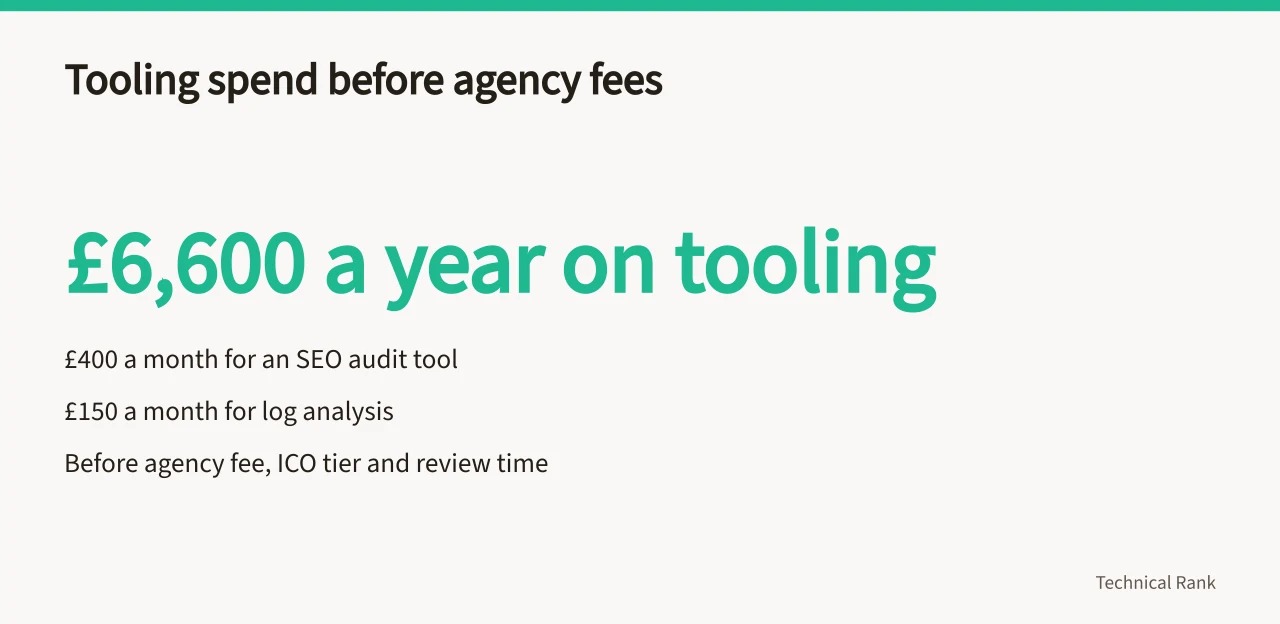
Tooling is only one line. Add the agency fee, internal developer time and the applicable ICO tier. For example, a team paying £400 a month for an SEO audit tool and £150 a month for log analysis spends £6,600 a year on tooling.
A monthly retainer of £1,500 to £4,000 adds £18,000 to £48,000 a year. Internal developer time might be two to five days a month. Use your own payroll figure for that.
What to leave out of the rubric
Do not score brand names, office locations or pitch polish. They do not change the deliverable.
Where the hidden costs appear
Most overspend happens after the audit lands. QA cycles, redirect mapping and content rewrites are rarely in the original quote, and the ecommerce audit checks show where they surface. Change requests, analytics tagging, schema updates and post-launch checks also appear late. Each one needs a named owner, a labelled estimate, a review date and a place in the project plan before you sign off.
The hidden costs and sources breakdown lists the items that appear late and how to put a labelled figure against each one before you sign.
If you need finance for a larger programme, the British Business Bank, the government-owned development bank, provides information on finance options for smaller firms. That is useful when deciding whether to phase the work.
Common questions
Should I ask for a fixed price or a day rate?
Ask for both. A fixed price suits a defined audit. A day rate with a monthly cap suits ongoing remediation, which depends on your release cycle. Compare twelve-month cost of ownership, not the headline figure.
How many quotes do I need?
Three is workable. Two is enough if both suppliers answer the rubric in writing. If a supplier will not put answers in writing, treat that as a signal, not a scheduling problem.
Do I need an agency at all?
Not always. If your developers can ship fixes and someone owns the crawl, an in-house hire plus tooling may cost less over a year; the four business models compare the options. Score the internal plan against the agency bids.
How often should the rubric change?
Review it when your platform, site architecture or reporting needs change. For most teams that is once or twice a year. Keep the weights stable between reviews so scores stay comparable.