

Reviews
Birmingham multi-site technical SEO compared with Leeds
Birmingham technical SEO prioritises location page duplication for multi-site retailers, while Leeds financial services firms need structured data and trust signals.
What to take away
- Birmingham technical SEO for multi-site retailers centres on canonicalisation and killing location page duplication across hundreds of near-identical store URLs.
- Leeds financial services firms carry a different loadcompliance wording, structured data for rich results, and trust signals that survive ICO and ASA scrutiny.
- Both cities need one canonical strategy, a crawl budget plan and Core Web Vitals monitoring.
- Structured data work in Leeds is about eligibility and accuracy, not volume; in Birmingham it is about local business markup per site.
- Tooling and reporting cadence should follow estate size and regulatory exposure, not a single template.
Why Birmingham multi-site retailers and Leeds financial firms diverge
Birmingham's retail estate runs through the Bullring, Grand Central and the surrounding West Midlands towns of Solihull, Sutton Coldfield and Wolverhampton.
The Works, headquartered in Sutton Coldfield, trades from several hundred UK stores. Chains trading along the M6, M5 and M42 corridor run store locators and regional landing pages that multiply with every opening.
Leeds holds the largest financial services cluster in the UK outside London. Leeds Building Society and First Direct are both headquartered in the city. Banks, building societies and insurers sit around Wellington Place, Leeds Dock and the city core, and firms there answer to the Financial Conduct Authority, the Information Commissioner's Office and the Advertising Standards Authority.
Their search visibility depends on pages that can be crawled, indexed and trusted, with claims that match the advertising codes.
A Birmingham retailer's audit starts with crawl efficiency and duplication. A Leeds financial firm's audit starts with structured data, page trust and compliance language. Same discipline, different order of operations.
That difference shapes budgets. Retail estates spend on log analysis and canonical hygiene. Financial firms spend on schema validation, content review and audit trails.
Birmingham multi-site audit priorities: location pages and duplication
Location page duplication is the first thing to measure in Birmingham. A retailer with 200 branches can generate 200 pages that differ only by address and phone number. Google treats many of these as near-duplicates, so rankings consolidate unpredictably.
Birmingham location page audit steps
- Crawl store locator and branch URLs
- Group pages by template
- Group by unique content volume
- Consolidate or rewrite thin pages
- Set one canonical per cluster
- Build crawlable internal links
Start with a full crawl of the store locator and every branch URL. Group pages by template, then by unique content volume. Pages under a threshold need either consolidation or genuine local content: opening hours, parking, services, staff specialisms.
Canonicalisation is the second priority. Where a branch page and a regional page target the same intent, one canonical must point to the stronger URL. Use the official guidance on how to specify a canonical when deciding between rel=canonical, redirects and parameter handling for filters and sort orders.
Internal linking is the third. Store locators often bury branch pages behind JavaScript or faceted navigation. Build crawlable paths from category pages, regional hubs and the sitemap. Keep the link depth shallow enough that a new branch is discoverable within days.
Audit an illustrative estate of 180 branch pages, the scale of a mid-sized West Midlands retail chain. Record four numbers before and after consolidation: indexed branch URLs, crawl requests to branch URLs, unique titles and H1s, and non-brand ranking positions for branch terms.
If 60 per cent of pages share titles or descriptions, indexed branch pages should rise and crawl requests to thin URLs should fall. Template quality, link depth and the number of merged URLs set the size of the move.
For estate-wide comparison, run a technical SEO competitor research exercise before committing to a template change.
Leeds financial services priorities: trust, structured data and compliance
Leeds financial services firms face a different audit. Trust signals matter more than raw page count. Users and search engines both look for named authors, regulatory registrations, clear contact details and a visible complaints process.
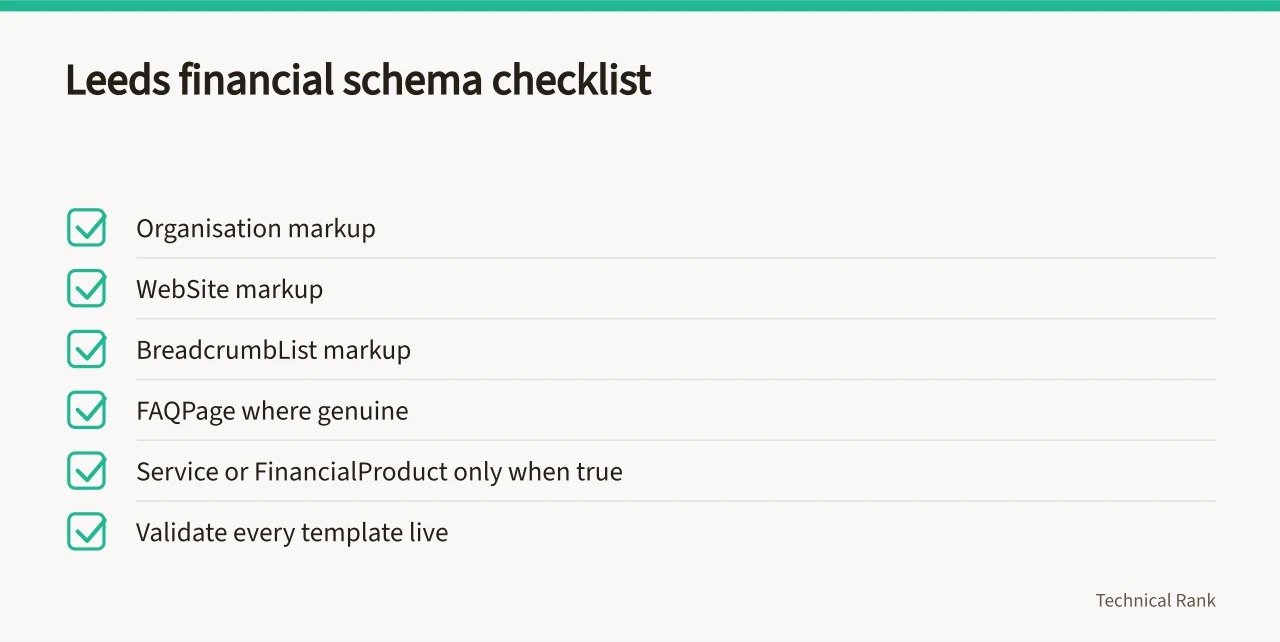
Structured data finance markup should describe the organisation, its services and its people accurately. Use the official structured data guidance to check which rich results are available and what each type requires. Incorrect markup is worse than none, because it can misrepresent a regulated product.
Compliance constrains content. The advertising codes set rules on claims, comparisons and financial promotions. Search snippets, meta descriptions and on-page copy all fall within scope. An audit should flag any claim that cannot be substantiated.
Data protection also shapes technical choices. The ICO expects lawful handling of enquiry forms and analytics. Cookie banners, consent mode and form data flows belong in the audit, not in a separate legal review.
Canonical, hreflang and internal linking across multi-site estates
Canonicalisation is the spine of any multi-site estate. One URL per intent, one canonical per cluster, and no conflicting signals between sitemaps, internal links and redirects. Where multiple URLs serve the same content, pick the canonical deliberately and apply it consistently.
Internal linking priorities by city
Birmingham retailers
- Link from
- Category pages
- Link to
- Branch and regional pages
- Trust target
- Store locator
- Crawl risk
- Faceted navigation
Leeds financial firms
- Link from
- Service hubs
- Link to
- Regulated product pages
- Trust target
- Author or team pages
- Crawl risk
- Gated content
Hreflang rarely applies to Birmingham or Leeds estates. If a UK group runs Irish or Welsh language variants, every annotation needs a return link and a valid language-region code.
Internal linking should reflect commercial priority. Birmingham retailers should link from high-authority category pages to their strongest branch and regional pages. Leeds financial firms should link from service hubs to regulated product pages and to author or team pages that carry trust.
Keep navigation crawlable. Faceted navigation on retail sites and gated content on financial sites both hide URLs from crawlers. Test with JavaScript disabled and with rendering enabled to see what actually reaches the index, using the official technical guidance on crawling, indexing and ranking as your reference.
A multi-site SEO audit should record the canonical decision for every template, not just the pages that currently rank. Template-level decisions prevent the same problem recurring at the next site launch.
Performance and accessibility checks for both city profiles
Core Web Vitals apply to both cities. Largest Contentful Paint, Interaction to Next Paint and Cumulative Layout Shift are the field metrics to watch. Use the Web Vitals definitions and thresholds when setting pass or fail lines for a template.
Performance focus by city
Birmingham retail
- Heavy assets
- Images and tags
- Main metric
- LCP
- Quick fix
- Compress and lazy load
- Test device
- Mid-range Android
Leeds financial
- Heavy assets
- Calculators and forms
- Main metric
- INP
- Quick fix
- Defer scripts
- Test device
- Desktop and mobile
Birmingham retail sites carry heavy imagery, store locators and third-party tags. Image compression, lazy loading below the fold and tag governance usually move the needle fastest. Test on a mid-range Android device over a mobile connection, not a desktop.
Leeds financial sites carry calculators, forms and consent scripts. These affect Interaction to Next Paint more than LCP. Reduce main-thread work, defer non-critical scripts and keep forms usable before consent is granted where the law allows.
Accessibility overlaps with technical SEO. Keyboard-navigable menus, labelled form fields and sufficient contrast help users and reduce the risk of complaints. They also improve how crawlers interpret interactive elements.
Run performance tests per template, not per site. A single slow template can drag a whole estate's field data down, and the fix is usually one component rather than a rebuild.
City-specific technical SEO checklists compared side by side
The table below sets the two profiles against each other.
City technical SEO checks compared
Birmingham retailers
- Primary risk
- Location duplication
- Canonical priority
- Branch consolidation
- Schema focus
- LocalBusiness, Store
- Compliance driver
- ASA offers
- Crawl priority
- Store locator
- Reporting cadence
- Monthly
Leeds financial firms
- Primary risk
- Missing structured data
- Canonical priority
- Product consolidation
- Schema focus
- Organisation, Service
- Compliance driver
- ASA, ICO, FCA
- Crawl priority
- Gated content
- Reporting cadence
- Quarterly
Birmingham multi-site retailers
- Primary technical risk
- Location page duplication
- Canonical priority
- Branch and regional page consolidation
- Structured data focus
- LocalBusiness, Store, BreadcrumbList
- Compliance driver
- ASA advertising codes on offers
- Crawl priority
- Store locator and faceted navigation
- Performance focus
- Images, third-party tags, locators
- Reporting cadence
- Monthly, tied to store openings
Leeds financial services firms
- Primary technical risk
- Inaccurate or missing structured data
- Canonical priority
- Product and service page consolidation
- Structured data focus
- Organisation, Service, FAQPage, author markup
- Compliance driver
- ASA codes, ICO data handling, FCA rules
- Crawl priority
- Gated content and form flows
- Performance focus
- Calculators, forms, consent scripts
- Reporting cadence
- Quarterly, tied to product and compliance cycles
Birmingham checklist:
- Crawl every branch and regional URL and group by template
- Identify pages with less than 30 per cent unique content
- Set one canonical per location cluster and document it
- Build crawlable internal links from category and regional hubs
- Validate LocalBusiness and Store markup on a sample of branches
- Test store locator rendering with JavaScript enabled and disabled
- Review image weight and third-party tag load per template
Leeds checklist:
- Validate Organisation and Service markup against live templates
- Check author and team pages for named, verifiable people
- Review all financial claims against the advertising codes
- Confirm consent and enquiry form data flows meet ICO expectations
- Test calculators and forms for Interaction to Next Paint
- Confirm canonical tags on product and service pages are self-referential
- Record an audit trail for every schema and content change
Both checklists should feed a single multi-site SEO audit register. That register becomes the evidence base for the next review.
Choosing tooling and reporting cadence for each city
Tooling should fit the estate in front of you. A Birmingham retailer tracking 200 branch URLs across the West Midlands needs different defaults from a Leeds firm validating a single gated mortgage calculator.
Choosing reporting cadence
Does the estate have active store openings?
Monthly reports tied to launches
Quarterly reports with error alerts
Named tools cover most of this work. Screaming Frog SEO Spider and Sitebulb run desktop crawls up to a few hundred branch URLs, while Lumar and Botify handle log file analysis at estate scale. Google Search Console, the Rich Results Test and the Schema Markup Validator handle indexing and schema checks.
Lighthouse, WebPageTest and PageSpeed Insights cover the Core Web Vitals.
When comparing platforms, run a technical SEO product comparison against your own templates and data volumes. Vendor demos rarely expose how a tool handles 200 near-duplicate URLs or a gated calculator page. Screaming Frog SEO Spider and Sitebulb both offer a free tier or trial, so the test can run before you buy.
Use a technical SEO selection checklist before signing, covering crawl scale, JavaScript rendering, API access, alerting and export formats. The same checklist should cover how the tool reports canonical conflicts and schema errors.
Reporting cadence should follow business rhythm. Birmingham retailers with active opening programmes need monthly reports tied to new store launches. Leeds financial firms with slower product cycles can work quarterly, with alerts for critical errors in between.
If you are weighing managed services against in-house work, a technical SEO supplier comparison helps frame cost, control and turnaround. For sign-off, a technical SEO quality checklist keeps the standard consistent across agencies and internal teams.
Whichever city you operate in, the audit should end with owners, dates and a re-test. Technical SEO decays when fixes are logged but never verified.